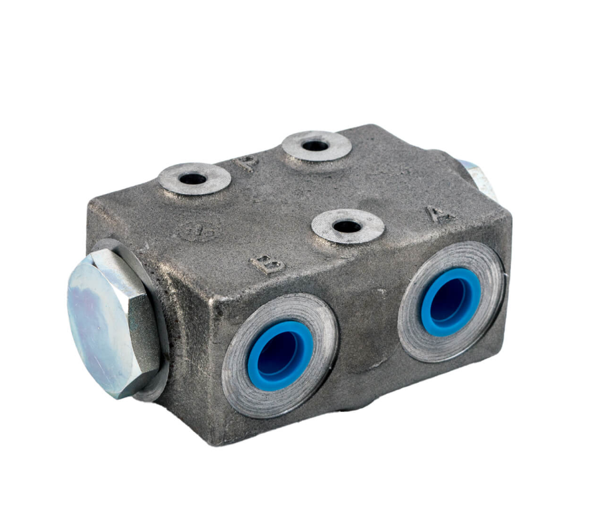
On a wide lift table, one hydraulic cylinder usually carries a different share of the load as the structure flexes and the centre of mass moves. A 50/50 divider-combiner stabilises the relationship between the two branch flows as their pressures separate. The volume delivered to each branch determines its cylinder travel – stroke equals oil volume divided by the effective piston area – which means that unequal branch pressures can add positional error by compressing the oil and deflecting the pipework and machine frame by different amounts.

Dynamic load at 15g
This raises an interesting question: How much skew can the mechanism accept before it needs a deliberate means of rephasing? Read on as we discuss how to predict twin cylinder position errors using a Webtec FDC60 Divider-Combiner.Webtex FDC60 Divider-Combiner
Rated-flow accuracy and rod separation
The Webtec FDC60 is pressure compensated in both divide and combine directions. Its ±2% accuracy is referenced to the Webtec valve’s rated maximum flow, so the maximum difference between the two outlets is 4% of that rated flow.
For the 10 l/min, 50/50 model, the nominal split is 5/5 l/min and the published maximum variation is 4.8/5.2 l/min. Positional separation for equal cylinders can therefore be estimated from:
Δx ≈ ΔQ,t / A
Across a 30-second extension, the 0.4 l/min branch difference represents 0.2 litres of unequal volume. With 63 mm bores, whose piston area is 3,117 mm², the worst-case arithmetic gives approximately 64 mm of rod separation. At 5 l/min total flow, the absolute allowance remains 0.4 l/min, making selection of the correct FDC60 flow code especially important. For retraction, the same relationship uses annular area. As that area is smaller than the full piston area, a given volume difference produces more rod travel.
Unequal load pressure and circuit compliance
Pressure compensation addresses the load-induced tendency for oil to favour the lower-pressure branch. As the higher-pressure branch consumes more delivered volume while the oil compresses and the hose and cylinder expand, frame deflection, mounting clearances, internal cylinder leakage and trapped air can add further movement that a flow-ratio valve won’t measure.
Recording both branch pressures and both rod positions through a hot, loaded cycle shows you whether the offset appears steadily with delivered volume or changes when the structure loads and unloads. Those are both different correction problems.
Reverse flow and rephasing
During retraction, the Webtec FDC60 holds the returning flows in the same ratio and combines them at port P. Reverse flow therefore preserves the selected ratio; positional correction needs a separate rephasing mechanism. Repeated leakage or operation below the selected flow range can carry an error from one cycle into the next. However, if the process accepts modest skew, a correctly sized divider-combiner may provide the required unison. Tighter positional tolerances will require a defined rephasing arrangement, a mechanical link or closed-loop control using position feedback.
What next?
Bore and rod diameters, stroke, working flow range, branch pressures, acceptable skew and the present end-of-stroke sequence are enough for us to help you resolve the twin-cylinder error budget. From there, we can size an FDC60 configuration and establish whether the circuit also needs rephasing or position feedback. To discuss your application with one of our specialists, please send us a message.