
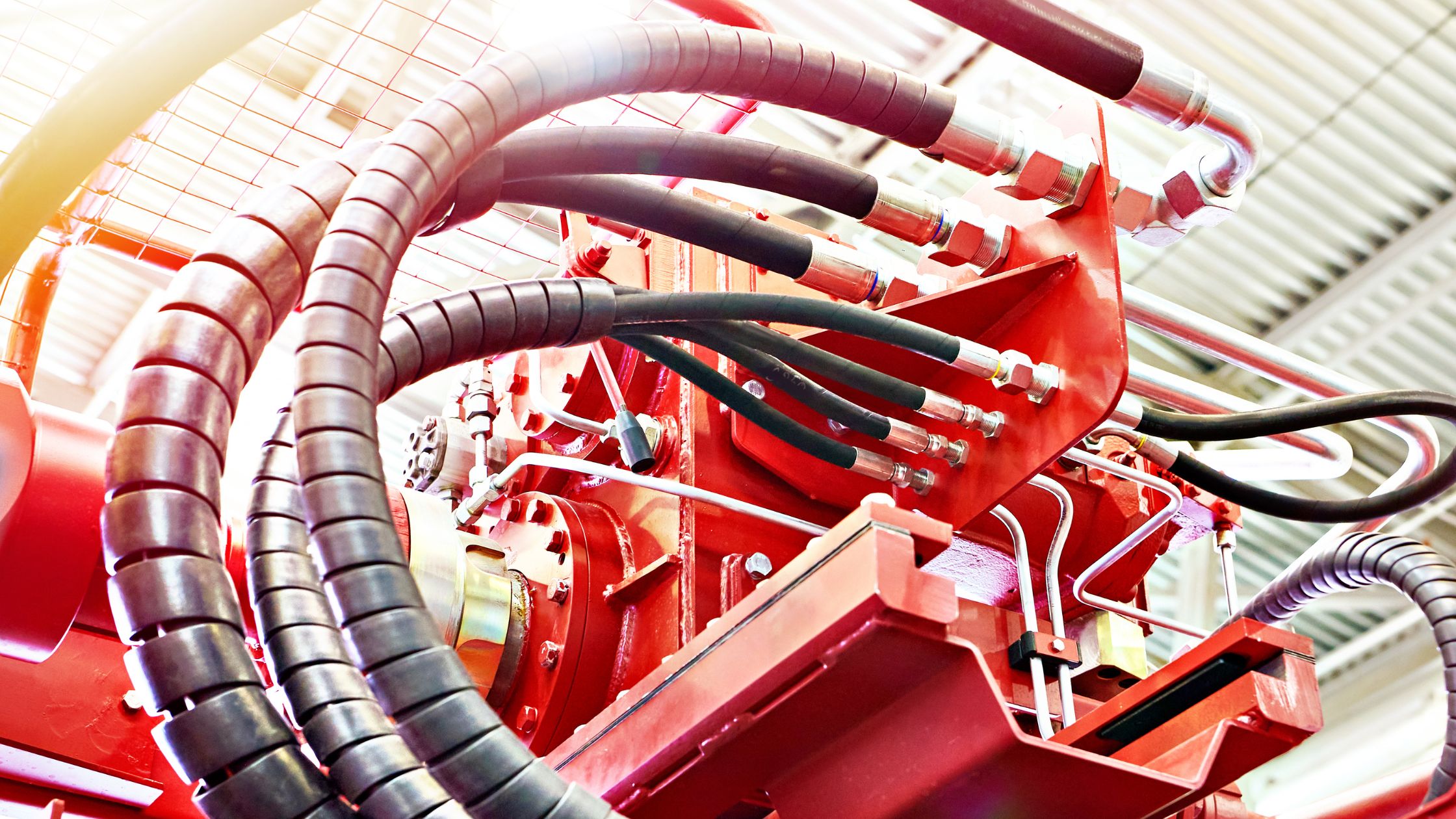
As infrastructure projects demand higher force output within increasingly constrained spaces (such as the hydraulics used in blade handling, nacelle positioning, and foundation work in offshore wind installations), fluid power systems are being designed to operate at progressively higher pressures. This trend is reflected in the scale of UK infrastructure investment, with total market sector spend reaching an estimated £20.3 billion in 2024 — a 16.9 % increase on the previous year — and general government infrastructure outlays rising to £28.9 billion. Alot of this public spending has been directed toward transport, water, energy and large-scale capital works where compact, powerful hydraulic equipment is essential.
This is important because higher pressures allow designers to reduce cylinder diameters, shorten stroke lengths, and minimise their overall system size, but these benefits also place greater demands on mechanical components.

In practice, raising operating pressure is not a simple efficiency gain. It also alters the stress distribution across hoses, fittings, and seals, increases sensitivity to installation errors, and reduces tolerance for wear or damage. Engineers working with modern hydraulic systems must therefore address pressure as a primary driver of fatigue life, safety margins, and long-term reliability, rather than simply a performance parameter.
Rising operating pressures and system design limits
Many modern mobile and industrial hydraulic systems now routinely operate at pressures exceeding 300 bar (4351 psi), with certain heavy-duty infrastructure applications approaching or exceeding 350 bar (5076 psi). In projects such as bridge jacking, rail maintenance plant operations, or deep foundation construction, these pressures are often necessary to generate sufficient lifting force within footprints constrained by site access and structural limitations.
However, increased operating pressure also raises hoop stress in hoses and fittings, and amplifies axial forces acting on terminations, so that even when components are correctly rated, repeated pressure cycling during normal operation accelerates fatigue. This is a worrying trend in infrastructure applications that see thousands of load cycles under varying conditions rather than steady-state operation, meaning that your design assumptions must account for fatigue behaviour over many years and not just peak load capacity.
How do materials behave under cyclic pressure?
At elevated operating pressures, materials and mechanical design are pushed to their absolute limit. Steel fittings, adapters, and couplings must withstand not only peak pressures but also the cyclic stress range. These can initiate microscopic cracks that cause fatigue failure over time. Surface finish, machining quality, and thread form also influence stress concentration, especially at interfaces where pressure-induced forces are transferred between parts.
Hydraulic hose assemblies introduce another layer of complexity. Reinforcement layers carry pressure loads, but how well they perform depends on the interaction between the hose body and the fitting. Inadequate internal support, incorrect crimp dimensions, or mismatches between hose and fitting geometry can lead to uneven load transfer, reducing hose life even when nominal pressure ratings are compliant.
High-pressure hose assemblies and fitting integrity
In high-pressure infrastructure applications, hose assemblies are often the most highly stressed elements of the system; they must accommodate pressure, vibration, movement, and environmental exposure simultaneously. For this reason, your choice of high-pressure hydraulic fittings and the quality of assembly are crucial engineering considerations.
Crimped fittings, such as Gates crimp fittings, are widely used because they provide consistent mechanical retention and sealing when assembled to specification. However, their reliability depends on precise control of the crimp diameter, correct hose insertion depth, and compatibility between hose construction and fitting geometry. Deviations as small as fractions of a millimetre can significantly affect grip strength and fatigue life, particularly at pressures above 300 bar. In bridge lifting or structural support projects, where hydraulic systems may remain pressurised for extended periods, even a minor leakage or fitting deformation can compromise system performance and require unplanned intervention.
Sealing performance and pressure spikes
While nominal operating pressure is a core design parameter, it is transient pressure spikes that often present the greatest risk to component integrity. Rapid valve closure, load shock, or sudden changes in flow can generate short-duration peaks well above the system’s working pressure. At higher baseline pressures, these spikes approach component limits more quickly, increasing the likelihood of seal extrusion and micro-leakage. In infrastructure projects where hydraulic systems may be exposed to contamination, temperature variation, or limited maintenance access, sealing performance becomes a critical determinant of service life. Engineers must specify sealing materials with the appropriate hardness, chemical compatibility, and extrusion resistance, and they must control tolerances in mating components to mitigate the effects of transient loads.
What next?
By addressing these risk factors systematically, design engineers can create hydraulic systems that sustain their performance and reliability even as rating pressures rise in response to the scale and intensity of modern infrastructure projects. To find out more or to discuss your project outcomes, please contact one of the team at Hydrastar today by clicking here.
Image Source: Canva